
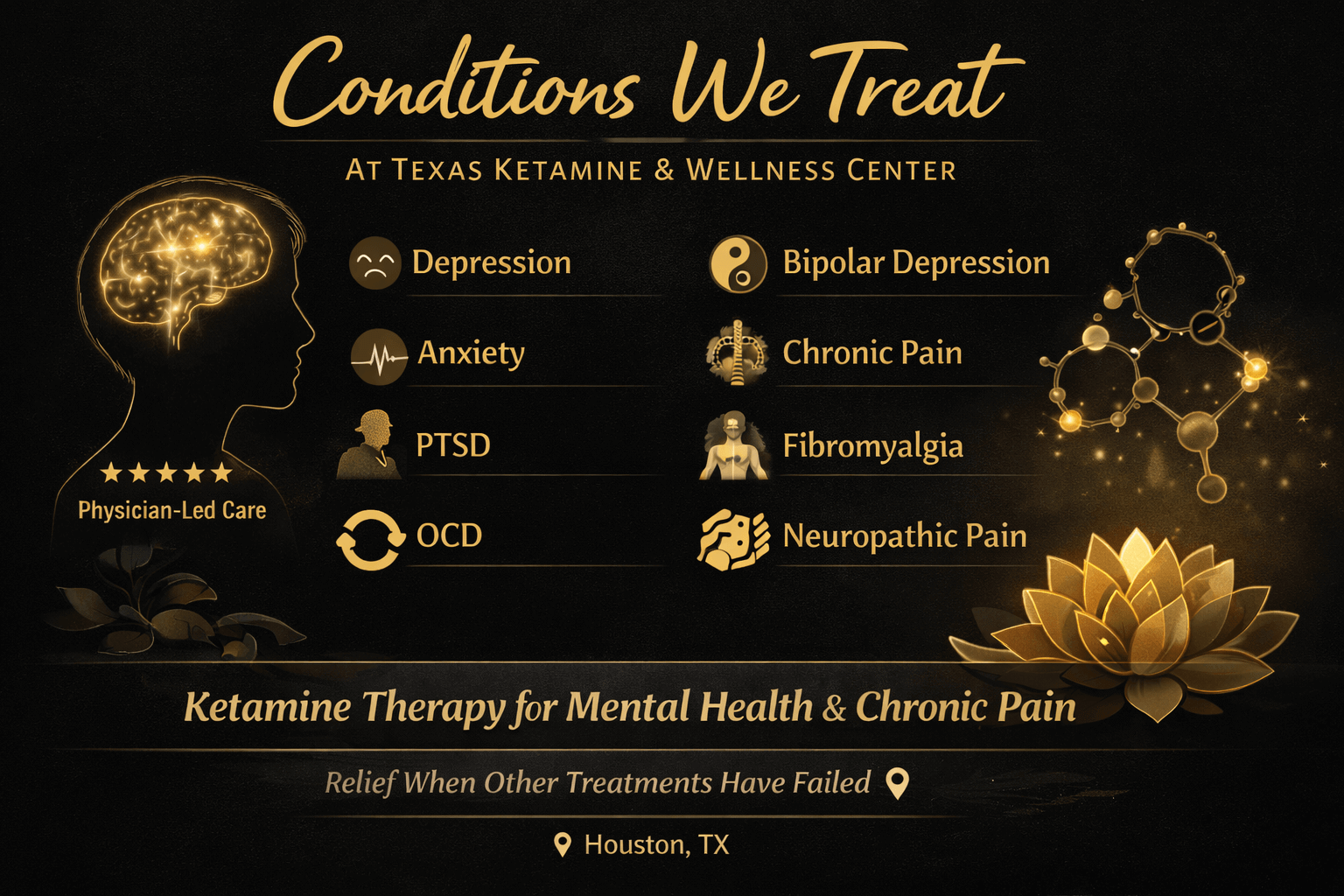
Conditions We Treat at Texas Ketamine & Wellness Center (Houston)
At Texas Ketamine & Wellness Center, we provide physician-led ketamine therapy in Houston for carefully selected patients with mental health and chronic pain conditions that have not improved with conventional treatment. Many individuals who contact our clinic have already tried combinations of medication management, psychotherapy, and lifestyle changes, yet continue to experience symptoms that limit their quality of life.
This page is your starting point. It’s designed as a central hub so you can quickly find your condition and explore dedicated pages for more detail. If you’re unsure which condition best matches what you’re experiencing, our team can guide you during a confidential consultation.
Common reasons patients consider ketamine therapy include:
Severe anxiety or panic symptoms
PTSD and trauma-related symptoms
OCD (treatment-resistant cases)
Bipolar depression (carefully selected cases)
Chronic pain syndromes, including CRPS and neuropathic pain
Important: Ketamine therapy is not appropriate for everyone. We prioritize medical screening, informed consent, and safe monitoring for every patient.
What Makes Ketamine Therapy Different?
Traditional antidepressants and anti-anxiety medications generally work through serotonin and norepinephrine pathways and may take weeks to provide noticeable benefit. Ketamine works through a different set of mechanisms, primarily involving NMDA receptor modulation and glutamate pathways, which are closely linked to neuroplasticity (the brain’s ability to form and revise connections).
In clinical practice, some patients report that ketamine helps reduce symptom intensity, emotional rigidity, and overwhelm—particularly when standard treatments have plateaued. However, response varies, and our clinic focuses on careful selection and realistic expectations.
Our approach is:
Physician-led and safety-first
Structured and monitored (vital signs and recovery observation)
Individualized to your history, goals, and response over time
Designed to complement—not replace—ongoing care when appropriate
Mental Health Conditions Treated
Treatment-Resistant Depression (TRD)
Depression can show up as more than sadness. Many patients experience emotional numbness, fatigue, reduced motivation, sleep disruption, irritability, or difficulty concentrating. When depression persists despite appropriate trials of antidepressants and therapy, it may be considered treatment-resistant depression.
Patients commonly explore ketamine therapy for depression when they’ve had:
Multiple medication trials with incomplete relief
Side effects limiting medication use
Ongoing symptoms despite therapy
Depression that disrupts work, relationships, or self-care
Goal of care: symptom reduction and improved function—while maintaining realistic expectations and ongoing reassessment.
➡️ Ketamine Therapy for Depression in Houston
Anxiety Disorders (including GAD, Panic, Social Anxiety)
Anxiety disorders can involve persistent worry, racing thoughts, physical tension, insomnia, irritability, or panic attacks. For many patients, anxiety is chronic—not situational—and may remain disruptive despite standard treatments.
We commonly evaluate:
Generalized Anxiety Disorder (GAD)
Panic disorder
Social anxiety
Anxiety co-occurring with depression or PTSD
Ketamine therapy may be considered for moderate-to-severe anxiety, particularly when traditional approaches have not been sufficient. Some patients report a calmer baseline and reduced reactivity after treatment.
➡️ Ketamine Therapy for Anxiety in Houston
Post-Traumatic Stress Disorder (PTSD)
PTSD may involve intrusive memories, hypervigilance, avoidance, mood changes, irritability, sleep disruption, or emotional numbing. Trauma-focused therapy remains foundational, yet symptoms can persist despite high-quality care.
Ketamine is being studied as an adjunct for PTSD due to its effects on neural circuits involved in fear response and emotional processing. While not a replacement for trauma therapy, ketamine may help some individuals reduce symptom burden enough to engage more effectively in ongoing treatment.
➡️ Ketamine Therapy for PTSD in Houston
Obsessive-Compulsive Disorder (OCD)
OCD is characterized by intrusive thoughts (obsessions) and repetitive behaviors or mental rituals (compulsions) performed to reduce distress. First-line treatment usually includes ERP therapy and medication.
For treatment-resistant OCD, ketamine has gained interest because OCD is strongly connected to glutamate signaling and specific brain circuit patterns. Response can vary and may be temporary, so we emphasize careful screening and coordination with ongoing therapy.
➡️ Ketamine Therapy for OCD in Houston
Bipolar Depression (Carefully Screened Cases)
Bipolar disorder requires precise diagnosis and careful management. Some individuals with bipolar disorder experience prolonged depressive episodes that are difficult to treat.
Ketamine therapy may be considered for bipolar depression in carefully selected patients, often with coordination involving the patient’s psychiatrist. We screen conservatively to reduce the risk of mood destabilization and ensure appropriate support.
➡️ Ketamine Therapy for Bipolar Depression in Houston
Suicidal Ideation (Non-Emergency Treatment Planning)
Ketamine has been studied for rapid reduction of suicidal ideation in controlled medical settings. However, it is not a substitute for emergency care.
If you are experiencing active suicidal thoughts with intent or plan, call 911 or go to the nearest emergency department.
For select patients with severe symptoms who are stable enough for outpatient evaluation, ketamine therapy may be considered as part of a comprehensive treatment plan and close follow-up.
➡️ Ketamine Therapy for Suicidal Ideation / Rapid Symptom Relief
Chronic Pain Conditions Treated
Chronic pain is not always purely “structural.” In many conditions, the nervous system becomes sensitized, amplifying pain signals. Ketamine has a well-established history of medical use and has been studied for certain pain syndromes, particularly where NMDA receptor activity contributes to pain sensitization.
We commonly evaluate the following:
Complex Regional Pain Syndrome (CRPS)
CRPS can involve severe pain, changes in skin color or temperature, swelling, and functional limitation, often after an injury or surgery. It can be challenging to treat and may significantly impact quality of life.
Ketamine therapy is sometimes considered for CRPS due to NMDA receptor involvement in pain sensitization. We evaluate each case individually to determine appropriateness.
➡️ Ketamine Therapy for CRPS in Houston
Neuropathic Pain
Neuropathic pain may present as burning, tingling, shooting, or electric sensations and can arise from nerve injury or dysfunction. Standard medications can provide partial relief but may not fully address symptoms.
Ketamine may be considered for refractory neuropathic pain in select patients, especially when symptoms significantly affect sleep and function.
➡️ Ketamine Therapy for Neuropathic Pain in Houston
Fibromyalgia and Central Sensitization Syndromes
Fibromyalgia often involves widespread pain, fatigue, sleep disturbance, brain fog, and heightened sensitivity. These symptoms are frequently linked to altered pain processing rather than localized tissue damage.
Ketamine therapy may be considered when conventional strategies have not provided adequate relief, particularly in patients with significant functional impairment.
➡️ Ketamine Therapy for Fibromyalgia in Houston
Chronic Migraine and Refractory Headache Disorders
Some patients with chronic migraine or refractory headache disorders seek additional options when typical preventive and abortive therapies have failed. Ketamine therapy may be explored in select cases as part of a broader, individualized plan.
➡️ Ketamine Therapy for Chronic Migraine in Houston
Cancer-Related Pain and Palliative Support (Select Cases)
Ketamine has been used in palliative care settings for complex or refractory pain. For select patients, ketamine therapy may be discussed as a supportive option when standard pain strategies are not sufficient.
➡️ Ketamine Therapy for Cancer-Related Pain in Houston
Conditions We Evaluate Carefully (and When Ketamine May Not Be Appropriate)
Not every patient is a candidate. We screen carefully for medical and psychiatric contraindications, including but not limited to:
Uncontrolled hypertension or certain cardiovascular conditions
Specific psychiatric diagnoses requiring specialized management
Active substance use disorder concerns
Medication interactions or safety considerations
If ketamine therapy is not appropriate, we will explain why and discuss alternative paths forward.
Our Commitment to Physician-Led Safety
Patients choose Texas Ketamine & Wellness Center because we emphasize:
Physician-led evaluation and oversight
Conservative treatment planning
Vital-sign monitoring and structured recovery observation
Clear education and informed consent
Coordination with your outside providers when appropriate
Our goal is to provide an environment where patients feel respected, informed, and supported.
Ready to Take the Next Step?
If you are exploring ketamine therapy for depression, anxiety, PTSD, OCD, bipolar depression, or chronic pain, we invite you to schedule a confidential consultation. We’ll review your history and help you determine whether ketamine therapy may be appropriate for your goals.
Helpful next steps:
Review our Medical Safety & Protocols page
Explore Pricing and Treatment Options
Learn about our Areas We Serveacross Houston and surrounding communities
Schedule a consultation
FAQ:
-
We commonly evaluate and treat treatment-resistant depression, severe anxiety disorders, PTSD, OCD (treatment-resistant cases), bipolar depression (carefully screened cases), and selected chronic pain conditions such as CRPS, neuropathic pain, fibromyalgia, and refractory headache disorders.
-
No. While ketamine is widely discussed for treatment-resistant depression, patients also explore ketamine therapy for severe anxiety, PTSD, OCD in select cases, and certain chronic pain syndromes. Eligibility depends on a physician consultation and safety screening.
-
We evaluate treatment-resistant OCD on a case-by-case basis. Ketamine is not a replacement for ERP therapy, and we encourage coordination with ongoing mental health care when appropriate.
-
Ketamine has a history of medical use in pain management and may be considered for select chronic pain conditions, particularly neuropathic pain and CRPS. Outcomes vary, and we determine suitability through clinical evaluation.
-
Some patients may not be candidates due to certain cardiovascular conditions, uncontrolled high blood pressure, specific psychiatric diagnoses requiring specialized care, active substance use disorder concerns, or other safety considerations. We review these factors in consultation.
-
Typically, ketamine is used as an adjunct to ongoing care, not a replacement. Many patients continue psychotherapy and medication management as clinically appropriate, with decisions guided by their treating clinicians.
-
If your main concern is low mood, loss of interest, or persistent depressive symptoms, start with depression. If your symptoms are worry, panic, or hyperarousal, start with anxiety. If trauma symptoms are central, start with PTSD. If intrusive thoughts and compulsions are primary, start with OCD. You can also schedule a consultation for guidance.
-
A referral is not required. Many patients self-refer, and we also welcome referrals from therapists, psychiatrists, and other clinicians.